Navigating 2026 Federal Student Loan Repayment Changes: Your Guide to New IDR Plans

Anúncios
Navigating the 2026 Federal Student Loan Repayment Changes: A Step-by-Step Guide to New Income-Driven Plans
The landscape of federal student loan repayment is undergoing significant transformations, with major changes slated to fully take effect by 2026. These updates, particularly the evolution of income-driven repayment (IDR) plans, are designed to make student loan debt more manageable for millions of borrowers. Understanding these student loan changes 2026 is not just beneficial; it’s essential for anyone with federal student loans to optimize their repayment strategy and potentially save thousands of dollars.
This comprehensive guide will walk you through everything you need to know about the upcoming shifts, focusing on the new SAVE plan, eligibility requirements, and practical steps to prepare. Whether you’re a recent graduate or a seasoned borrower, these changes will impact your financial future. Let’s dive deep into how to navigate these significant federal student loan adjustments.
Anúncios
Understanding the Genesis of the 2026 Federal Student Loan Repayment Changes
The journey to the student loan changes 2026 began with a recognition that the existing federal student loan system, while offering various repayment options, often left borrowers feeling overwhelmed and burdened. High monthly payments, accruing interest, and complex eligibility rules for forgiveness programs created a challenging environment. In response, the U.S. Department of Education has been progressively implementing reforms aimed at simplifying the process, reducing financial strain, and providing clearer pathways to debt relief.
These reforms culiminated in the creation of the Saving on a Valuable Education (SAVE) plan, which is set to fully replace the Revised Pay As You Earn (REPAYE) plan by July 2024, with additional benefits rolling out in 2026. The goal is to create a more equitable and sustainable repayment system. The core philosophy behind these changes is to ensure that monthly payments are truly affordable, interest accrual doesn’t lead to ballooning balances, and forgiveness is more accessible for long-term borrowers.
Anúncios
For many, the prospect of managing student loans can be daunting. The good news is that these student loan changes 2026 are largely designed to benefit borrowers, offering more generous terms and clearer paths to financial freedom. However, understanding the nuances of these changes is crucial to leveraging them effectively. This guide will serve as your compass through the evolving landscape of federal student aid.
The SAVE Plan: A Cornerstone of the 2026 Student Loan Changes
The SAVE plan stands as the most significant development among the upcoming student loan changes 2026. It builds upon the framework of previous income-driven repayment plans but introduces several key enhancements that offer substantial relief to many borrowers. For anyone currently on an IDR plan, or considering one, the SAVE plan will likely be your best option.
Key Features and Benefits of the SAVE Plan
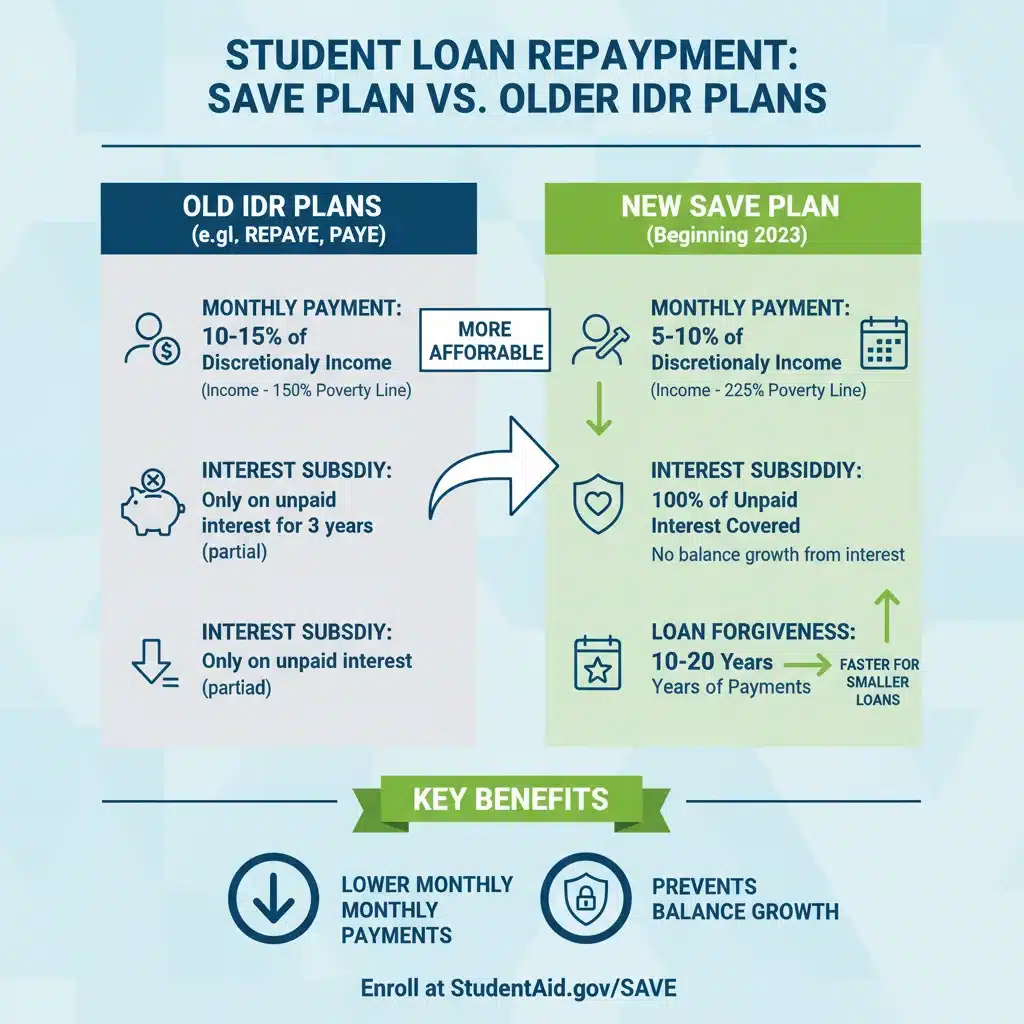
- Lower Monthly Payments: For undergraduate loans, monthly payments will be cut from 10% to 5% of a borrower’s discretionary income. Borrowers with both undergraduate and graduate loans will pay a weighted average between 5% and 10% of their discretionary income. This is a massive reduction for many.
- Increased Income Protection: The amount of income considered “discretionary” has been increased from 150% to 225% of the federal poverty line. This means more of your income is protected, leading to even lower monthly payments for many borrowers, especially those with lower incomes. For example, a single borrower earning $32,800 annually would have a $0 monthly payment under SAVE, compared to $120 under the old REPAYE plan.
- No Unpaid Interest Accumulation: This is perhaps one of the most transformative aspects of the SAVE plan. If your monthly payment doesn’t cover the full amount of interest due, the government will cover the remaining interest. This means your loan balance won’t grow due to unpaid interest, preventing the dreaded “negative amortization” that plagued many borrowers on older IDR plans. This feature alone can save borrowers thousands of dollars over the life of their loan and prevent balances from spiraling out of control.
- Shorter Path to Forgiveness for Smaller Balances: Borrowers with original principal balances of $12,000 or less can receive forgiveness after just 10 years of payments. For every additional $1,000 borrowed above $12,000, one additional year of payments is required, capped at 20 or 25 years. This accelerates forgiveness for a significant portion of borrowers, particularly those who attended community college or took out smaller loans.
- Automatic Enrollment for Certain Borrowers: While not fully automatic for everyone, efforts are being made to streamline enrollment and recertification for borrowers, making it easier to stay on track.
The SAVE plan is designed to be the most affordable income-driven repayment plan ever offered by the Department of Education. For many borrowers, it will result in significantly lower monthly payments and prevent their loan balances from growing due to interest. These are critical components of the student loan changes 2026 that aim to provide genuine financial relief.
Who Benefits Most from the SAVE Plan and Other 2026 Changes?
While the student loan changes 2026, particularly the SAVE plan, are broadly beneficial, certain groups of borrowers stand to gain the most:
- Low- to Middle-Income Borrowers: The increased income protection and reduced discretionary income percentage for payments mean that borrowers with lower incomes will see their monthly payments drop significantly, with many qualifying for $0 payments.
- Borrowers with High Interest Rates: The interest subsidy feature is a game-changer for those whose monthly payments don’t cover their accruing interest. This prevents balances from growing, offering substantial long-term savings.
- Borrowers with Smaller Original Loan Balances: The accelerated forgiveness timeline for loans under $12,000 provides a quicker path to debt freedom, which is particularly impactful for community college attendees or those with a few semesters of college.
- Single Borrowers or Those with Few Dependents: The increase in protected income (225% of the poverty line) means that a larger portion of their income is excluded from the payment calculation, leading to lower payments.
- Public Service Loan Forgiveness (PSLF) Candidates: While PSLF has its own set of rules, being on an IDR plan like SAVE is a prerequisite. Lower monthly payments under SAVE can make it easier to afford the 120 qualifying payments needed for PSLF.
Understanding if you fall into one of these categories can help you prioritize enrolling in the SAVE plan as part of your strategy to navigate the student loan changes 2026.
A Step-by-Step Guide to Preparing for the 2026 Student Loan Changes
Preparing for the student loan changes 2026 requires proactive steps. Don’t wait until the last minute to evaluate your options. Here’s a step-by-step guide:
Step 1: Understand Your Current Loan Portfolio
Before you can make informed decisions, you need a clear picture of your federal student loans. Log in to your Federal Student Aid (FSA) account at studentaid.gov. Here you can view:
- Loan Types: Are they Direct Loans, FFEL loans, Perkins loans? Direct Loans are generally eligible for all IDR plans, including SAVE. FFEL and Perkins loans may need to be consolidated into a Direct Consolidation Loan to qualify.
- Loan Balances: Know the principal and interest accrued on each loan.
- Interest Rates: Understand the rates on your various loans.
- Current Repayment Plan: Are you on a Standard, Graduated, Extended, or an existing IDR plan (PAYE, IBR, ICR, REPAYE)?
Having this information readily available is the first critical step in navigating the student loan changes 2026.
Step 2: Evaluate Your Eligibility for the SAVE Plan
Most federal student loan borrowers with Direct Loans are eligible for the SAVE plan. If you have FFEL or Perkins loans, you will likely need to consolidate them into a Direct Consolidation Loan to qualify. This consolidation process can take several weeks, so don’t delay if you need to do it. Be aware that consolidating might reset your payment count for forgiveness programs if not handled correctly, but recent adjustments have made it more favorable for those with older IDR payments.
Step 3: Calculate Potential Payments Under SAVE
The FSA website offers a loan simulator tool that can help you estimate your monthly payments under various plans, including SAVE. Input your income, family size, and state of residence to get a personalized estimate. This will allow you to see the direct impact of the student loan changes 2026 on your budget.
Remember, the payment calculation under SAVE is:
- (Adjusted Gross Income – 225% of Federal Poverty Line) x 5% (for undergraduate loans) or a weighted average (for mixed loans) / 12 months.
This calculation will often result in significantly lower payments than older IDR plans.
Step 4: Consider Consolidating Your Loans (If Necessary)
If you have FFEL or Perkins loans, or if you have multiple Direct Loans and want to simplify your repayment, consider a Direct Consolidation Loan. This combines multiple federal loans into a single new Direct Loan with a single monthly payment and a weighted average interest rate. Crucially, it makes otherwise ineligible loans eligible for the SAVE plan and PSLF.
Important Note on Consolidation and Forgiveness: Recent temporary changes allow past payments on consolidated loans to count towards IDR and PSLF forgiveness, even for periods before consolidation. This is a significant benefit for long-term borrowers. However, these benefits are temporary, so investigate the deadlines if you have older loans and want to consolidate to maximize your forgiveness timeline under the student loan changes 2026.
Step 5: Apply for or Switch to the SAVE Plan
If you’re already on an IDR plan, you can switch to the SAVE plan. If you’re not on an IDR plan, you can apply directly. The application is available on studentaid.gov. You’ll need to provide information about your income and family size. You can apply online or submit a paper application.
Don’t wait until 2026 to make this switch. Many benefits of the SAVE plan are already in effect, with the full undergraduate loan payment reduction coming in July 2024. The earlier you switch, the sooner you can benefit from lower payments and interest subsidies, directly leveraging the improvements brought by the student loan changes 2026.
Step 6: Understand Annual Recertification
To remain on an IDR plan, including SAVE, you must recertify your income and family size annually. Failure to do so can result in your payments increasing and any unpaid interest capitalizing (being added to your principal balance). The Department of Education is working to make recertification more automatic for some borrowers by allowing them to consent to share their tax information directly, but it’s crucial to stay on top of this requirement.
Mark your calendar for your recertification date and be prepared to submit updated documentation. This is a critical ongoing responsibility when managing your loans under the student loan changes 2026.
Additional Considerations Beyond the SAVE Plan
While the SAVE plan is a major part of the student loan changes 2026, there are other important aspects to consider:
Public Service Loan Forgiveness (PSLF)
The PSLF program has also seen significant improvements, making it more accessible for public service workers. While the temporary PSLF waiver has ended, the underlying program remains, and being on an IDR plan like SAVE is essential for qualifying payments. If you work for a government agency or a qualifying non-profit, ensure you are tracking your employment and submitting PSLF Employment Certification Forms regularly.
The lower payments offered by the SAVE plan can make it much easier to make the 120 qualifying payments required for PSLF, aligning perfectly with the broader goals of the student loan changes 2026 to support borrowers.
Student Loan Forgiveness and Discharge Programs
Beyond IDR forgiveness and PSLF, other avenues for relief exist:
- Total and Permanent Disability (TPD) Discharge: For borrowers with a total and permanent disability.
- Borrower Defense to Repayment: For borrowers who were misled by their schools.
- Closed School Discharge: If your school closed while you were enrolled or shortly after you withdrew.
- Death Discharge: Federal student loans are discharged upon the borrower’s death.
Stay informed about these programs, as eligibility criteria and application processes can change. These options, alongside the student loan changes 2026, provide a safety net for various life circumstances.
Avoiding Scams
With any major federal program change, scam artists emerge. Be wary of companies promising instant forgiveness or demanding upfront fees for services you can get for free from the Department of Education. Always go directly to studentaid.gov for information and to manage your federal student loans. Never share your FSA ID or password with anyone.

Long-Term Impact of the 2026 Student Loan Changes
The full implementation of the student loan changes 2026 is expected to have a profound and positive long-term impact on millions of Americans. By significantly reducing monthly payments, preventing interest capitalization, and accelerating forgiveness for many, these reforms aim to:
- Reduce Financial Stress: Lower payments free up income, allowing borrowers to better afford housing, groceries, and other necessities, and to save for other financial goals.
- Boost Economic Activity: With less disposable income tied up in student loan payments, borrowers are more likely to spend, save, and invest, contributing to broader economic growth.
- Improve Creditworthiness: Manageable payments reduce the likelihood of default, helping borrowers maintain good credit scores.
- Promote Educational Attainment: By making college more financially accessible and reducing the long-term burden of debt, these changes may encourage more individuals to pursue higher education.
- Address Systemic Inequities: The changes are particularly beneficial for low-income borrowers and those from disadvantaged backgrounds, helping to close wealth gaps exacerbated by student debt.
These student loan changes 2026 represent a significant policy shift towards a more borrower-centric approach to federal student aid. While no system is perfect, these reforms are a substantial step towards making higher education a pathway to opportunity, not a lifelong financial burden.
Frequently Asked Questions About the 2026 Student Loan Changes
Q: When do the full SAVE plan benefits take effect?
A: Some benefits, like the interest subsidy, are already in effect. The full reduction of undergraduate loan payments from 10% to 5% of discretionary income will take effect in July 2024. The accelerated forgiveness timelines for smaller balances also started in early 2024. The term “2026 changes” refers to the complete integration and long-term impact of these reforms.
Q: Will my loan balance still grow under the SAVE plan?
A: No, this is one of the most significant benefits. If your monthly payment doesn’t cover all the interest, the government covers the remaining interest. Your loan balance will not grow due to unpaid interest while you are on the SAVE plan.
Q: Do I need to reapply for the SAVE plan every year?
A: Yes, you must recertify your income and family size annually to remain on any income-driven repayment plan, including SAVE. However, efforts are being made to streamline this process, potentially allowing for automatic recertification if you consent to share your tax data.
Q: What if I have private student loans? Do these changes apply to me?
A: No, the student loan changes 2026 and the SAVE plan specifically apply only to federal student loans. Private student loans have different terms and repayment options determined by the private lender. You should contact your private loan servicer for options related to those loans.
Q: Can I switch from another IDR plan to the SAVE plan?
A: Yes, you can switch from any other income-driven repayment plan (PAYE, IBR, ICR) to the SAVE plan. In most cases, it is advisable to do so due to the more generous terms of the SAVE plan.
Q: What happens if I miss a payment on the SAVE plan?
A: Missing payments can still lead to delinquency and potentially default, impacting your credit score. It’s crucial to make your payments on time or contact your loan servicer immediately if you anticipate difficulty. The SAVE plan is designed to make payments affordable, so ensure your income and family size are accurately reported during recertification to reflect your current financial situation.
Conclusion: Embracing the Future of Federal Student Loan Repayment
The student loan changes 2026 mark a pivotal moment for federal student loan borrowers. The introduction and full implementation of the SAVE plan represent a significant step towards creating a more equitable, affordable, and sustainable repayment system. By reducing monthly payments, eliminating interest capitalization, and offering faster paths to forgiveness for many, these reforms are poised to alleviate financial burdens and empower borrowers to achieve greater financial stability.
Being proactive is key. Take the time to understand your loans, evaluate your options under the new SAVE plan, and take the necessary steps to enroll or switch. Utilize the resources available on studentaid.gov and don’t hesitate to contact your loan servicer if you have questions. By strategically navigating these student loan changes 2026, you can significantly improve your financial outlook and move closer to a debt-free future.