Mastering Prompt Engineering: Your Guide to AI Communication Excellence

Anúncios
In the rapidly evolving landscape of artificial intelligence, the ability to communicate effectively with AI models has become a critical skill. This is where prompt engineering comes into play. Far from being a mere technicality, prompt engineering is the art and science of crafting inputs (prompts) that guide AI models to generate desired outputs. Whether you’re using ChatGPT, DALL-E, Midjourney, or any other large language model (LLM) or generative AI, understanding how to engineer effective prompts is paramount to unlocking their full potential. This comprehensive Prompt Engineering Guide will delve deep into the methodologies, best practices, and advanced techniques required to master this essential discipline.
Anúncios
The rise of sophisticated AI tools has democratized access to powerful computational capabilities, but with great power comes the need for precise instruction. Without well-engineered prompts, AI models can produce irrelevant, inaccurate, or even harmful content. Conversely, a carefully constructed prompt can transform a generic AI response into a highly specific, creative, and valuable output. This guide is designed for anyone looking to enhance their AI communication skills, from beginners exploring their first AI interactions to seasoned professionals aiming to optimize their AI workflows.
We will explore the foundational principles of prompt engineering, moving through practical examples and advanced strategies that will empower you to consistently achieve superior results. By the end of this guide, you will not only understand the ‘what’ and ‘why’ of prompt engineering but also the ‘how’ – equipped with a robust toolkit to craft prompts that truly make a difference.
Anúncios
Understanding the Core of Prompt Engineering
At its heart, prompt engineering is about clarity, context, and constraint. AI models, particularly LLMs, are designed to predict the next best word or sequence of words based on the input they receive and the vast amount of data they were trained on. Your prompt acts as the primary directive, steering this predictive engine towards your desired outcome. Think of it as providing a highly intelligent but literal assistant with instructions. The more precise and comprehensive your instructions, the better the assistant can perform its task.
Why is Prompt Engineering So Important?
- Accuracy and Relevance: Well-crafted prompts reduce ambiguity, leading to more accurate and relevant outputs.
- Efficiency: By getting it right the first time, you minimize the need for iterative refinements, saving time and computational resources.
- Creativity and Innovation: Strategic prompts can push AI models beyond generic responses, fostering innovative and unique content generation.
- Control and Safety: Engineering prompts allows users to guide AI behavior, mitigating the risk of generating undesirable or harmful content.
- Resource Optimization: For businesses and developers, optimized prompts can lead to more efficient use of API calls and computing power.
The field is dynamic, with new techniques and best practices emerging regularly. Staying informed and continuously experimenting is key to mastering this crucial skill. This Prompt Engineering Guide will provide you with a solid foundation to navigate this evolving landscape.
Foundational Principles for Effective Prompts
Before diving into specific techniques, let’s establish some universal principles that underpin all effective prompt engineering. Adhering to these principles will significantly improve the quality of your AI interactions, regardless of the specific model or task.
1. Be Clear and Specific
Vague prompts lead to vague answers. Always strive for utmost clarity and specificity in your instructions. Instead of saying, “Write about climate change,” try “Write a 500-word article for a general audience explaining the causes and effects of climate change, focusing on actionable steps individuals can take.”
2. Provide Sufficient Context
AI models lack real-world understanding; they operate on patterns learned from data. Therefore, providing adequate context is crucial. If you’re asking for a summary of a document, include the document. If you want a character description, provide background information about the story they belong to.
3. Define the Desired Output Format
Explicitly state how you want the output to be structured. Do you need a list, a paragraph, a JSON object, a table, or a specific length? “Summarize this text in three bullet points” is much more effective than just “Summarize this text.”
4. Set Constraints and Boundaries
Constraints help the AI stay within desired parameters. This could involve word counts, tone of voice, target audience, style guidelines, or even specific keywords to include or avoid. For example, “Write a persuasive email, no more than 150 words, using a formal tone, to convince a potential client to schedule a demo.”
5. Use Examples (Few-Shot Learning)
One of the most powerful techniques is providing examples of desired input-output pairs. This is known as few-shot learning. If you want the AI to generate a specific type of response, show it one or two examples of how that response should look. For instance, if you want to classify sentiment, provide examples like: “Text: ‘I love this product!’ Sentiment: Positive. Text: ‘This is terrible.’ Sentiment: Negative. Text: ‘The weather is okay.’ Sentiment: Neutral. Text: [Your new text] Sentiment: “
6. Break Down Complex Tasks
For highly complex requests, it’s often more effective to break them down into smaller, manageable steps. Guide the AI through a multi-step process rather than expecting it to handle everything in one go. This can involve chaining prompts, where the output of one prompt becomes the input for the next.
7. Iterate and Refine
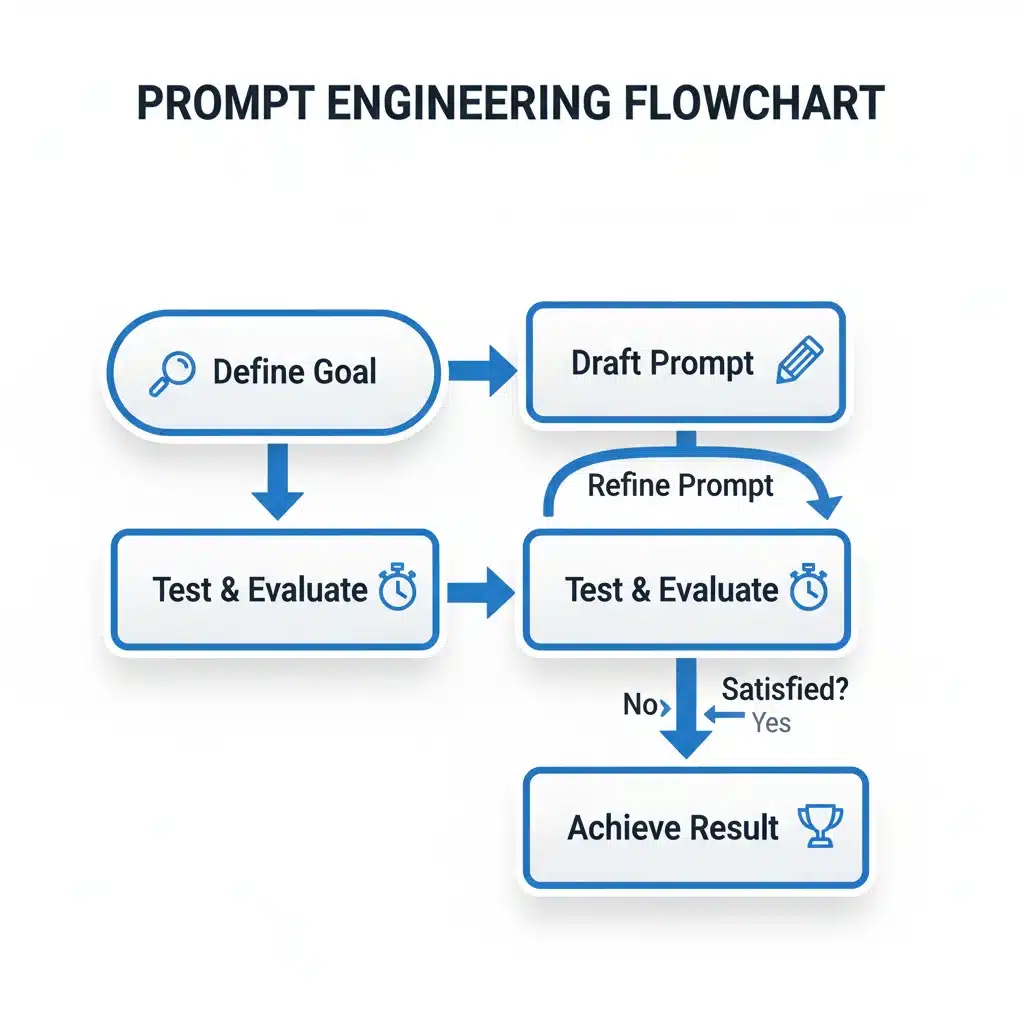
Prompt engineering is rarely a one-shot process. Expect to iterate. Start with a basic prompt, evaluate the output, identify shortcomings, and refine your prompt based on the results. This iterative loop is fundamental to achieving optimal outcomes.
Basic Prompt Engineering Techniques
With the foundational principles in mind, let’s explore some practical techniques to apply when crafting your prompts. These techniques form the core of any effective Prompt Engineering Guide.
1. Direct Instruction
This is the most straightforward approach: tell the AI exactly what you want it to do. Use clear verbs and a direct tone.
- Example: “Translate the following English text into Spanish: ‘Hello, how are you?'”
- Example: “Generate five ideas for a blog post about sustainable living.”
2. Role-Playing
Assigning a persona to the AI can significantly influence its tone, style, and content. This is incredibly useful for tailored outputs.
- Example: “Act as a seasoned travel blogger. Write a vivid description of a hidden gem beach in Thailand.”
- Example: “You are a cybersecurity expert. Explain the concept of phishing to a non-technical audience.”
3. Delimiters
Using delimiters (like triple quotes, XML tags, or specific characters) helps the AI distinguish between instructions and the content it needs to process. This is especially useful when providing long passages of text or multiple pieces of information.
- Example: “Summarize the following text, enclosed in triple quotes, into a single paragraph: “`The history of the internet is a complex tapestry of technological innovation, scientific research, and social change…“`”
- Example: “Extract all product names from the following review: <review>I love my new <product>SmartWatch X</product> but the <product>Wireless Earbuds Pro</product> were a disappointment.</review>”
4. Chain of Thought Prompting
This technique encourages the AI to ‘think step-by-step’ before providing a final answer. It often leads to more accurate and logical reasoning, especially for complex problems.
- Example: “Solve the following math problem: If a train travels at 60 mph for 2 hours, and then at 40 mph for 3 hours, what is the total distance traveled? Think step-by-step.”
- Example: “Explain why photosynthesis is important for life on Earth. First, describe the process, then its outputs, and finally its global impact.”
5. Temperature and Top-P Settings (Advanced)
While not strictly part of the prompt text itself, understanding model parameters like ‘temperature’ and ‘top-p’ is crucial for prompt engineers. These settings control the randomness and creativity of the AI’s output.
- Temperature: A higher temperature (e.g., 0.8-1.0) leads to more creative and varied outputs, while a lower temperature (e.g., 0.2-0.5) makes the output more deterministic and focused.
- Top-P: Similar to temperature, top-p controls the diversity of the output by sampling from a smaller set of words whose cumulative probability exceeds the top-p value.
Experimenting with these settings, often available in AI model interfaces or APIs, can significantly fine-tune your results.
Advanced Prompt Engineering Strategies
Once you’ve mastered the basics, you can move on to more sophisticated strategies to extract even greater value from AI models. These techniques are often employed by professional prompt engineers and can elevate your AI interactions to an expert level.
1. Iterative Prompt Development (Refinement Loop)
As mentioned earlier, iteration is key. This strategy involves a systematic approach to refining your prompts. Start broad, then narrow down. Test, analyze, and adjust. This iterative process is a cornerstone of effective prompt engineering.
- Initial Prompt: “Write a marketing email.” (Too vague)
- First Iteration: “Write a marketing email for a new online course on digital photography, targeting beginners.” (Better, but still generic)
- Second Iteration: “Act as a friendly photography instructor. Write a marketing email for a new online course, ‘Photography for Beginners: Master Your DSLR,’ launching next month. Highlight benefits like ‘learn composition,’ ‘understand lighting,’ and ‘edit like a pro.’ Include a call to action to sign up for early bird discounts. Keep it under 200 words.” (Much more specific and effective)
2. Negative Constraints / Anti-Prompts
Sometimes, telling the AI what *not* to do can be as effective as telling it what to do. This helps avoid common pitfalls or unwanted elements in the output.
- Example: “Write a short story about a detective solving a mystery. Do NOT include any supernatural elements or time travel.”
- Example: “Generate product descriptions for a new line of eco-friendly cleaning supplies. Avoid using overly technical jargon.”
3. Self-Correction / Self-Reflection Prompts
For complex tasks, you can prompt the AI to critically evaluate its own output and suggest improvements or corrections. This mimics a human review process.
- Example (Two-part prompt):
- “Generate a five-paragraph essay on the impact of social media on mental health.”
- “Review the essay you just wrote. Identify any logical fallacies, grammatical errors, or areas where the argument could be strengthened. Then, rewrite the essay incorporating these improvements.”
4. Structured Data Input and Output
When working with large datasets or requiring highly structured outputs, explicitly asking for JSON, XML, or CSV formats can be incredibly powerful for subsequent processing.
- Example: “Extract the following information from the text below and present it as a JSON object with ‘name’, ‘age’, and ‘occupation’ fields: ‘John Doe is 35 years old and works as a software engineer. Jane Smith, a 28-year-old graphic designer, lives next door.'”
5. Few-Shot CoT (Chain of Thought with Examples)
Combine few-shot learning with chain-of-thought prompting. Provide examples where the AI demonstrates its reasoning process step-by-step, then ask it to apply the same reasoning to a new problem.
- Example: “Here are some examples of how to solve word problems:
Problem: Mary has 5 apples. She buys 3 more. How many does she have now?
Thought: Start with 5 apples. Add 3 more. 5 + 3 = 8.
Answer: 8 apples.
Problem: John has 10 cookies. He eats 4. How many are left?
Thought: Start with 10 cookies. Subtract 4. 10 – 4 = 6.
Answer: 6 cookies.
Problem: Sarah has 7 pencils. She gives 2 to her friend. How many does she have left? Think step-by-step.
“
6. Tree of Thought (ToT)
An even more advanced technique than CoT, ToT encourages the AI to explore multiple reasoning paths and self-evaluate them to find the best solution. This often involves generating multiple intermediate thoughts or ideas and then pruning them.
- Example: “For the given complex problem (e.g., designing a marketing strategy for a new product), generate three distinct approaches. For each approach, outline the pros and cons, and then select the most promising one, explaining your rationale.”

Common Pitfalls to Avoid
Even with the best intentions, prompt engineering can be tricky. Here are some common mistakes to watch out for:
- Over-Prompting: Providing too much unnecessary information can confuse the AI or dilute your core instruction. Be concise.
- Under-Prompting: Not giving enough context or specific instructions often leads to generic or unhelpful responses.
- Ambiguity: Using vague language or terms that can be interpreted in multiple ways will result in inconsistent outputs.
- Ignoring Model Limitations: Different AI models have different strengths and weaknesses. A prompt that works well for a creative writing task might fail for a complex mathematical problem on the same model. Understand your model’s capabilities.
- Lack of Iteration: Expecting perfect results on the first try is unrealistic. Embrace the iterative refinement process.
- Bias in Prompts: Be mindful of any unintentional biases in your prompts that could lead to biased or unfair AI outputs.
- Forgetting the Target Audience: If the AI is generating content for a specific audience, ensure your prompt reflects that audience’s needs and understanding.
Tools and Resources for Prompt Engineers
The field of prompt engineering is supported by a growing ecosystem of tools and resources:
- AI Playground Environments: Platforms like OpenAI’s Playground, Google AI Studio, or Hugging Face Spaces offer interactive environments to test and refine prompts.
- Prompt Libraries and Marketplaces: Websites like PromptBase or FlowGPT provide examples and even sell high-performing prompts for various tasks.
- Community Forums: Engaging with communities on Reddit (e.g., r/promptengineering), Discord, or dedicated AI forums can provide valuable insights and solutions.
- Official Documentation: Always refer to the official documentation of the AI model you are using, as it often contains specific guidelines and best practices for prompting that particular model.
- Online Courses and Tutorials: Numerous educational platforms offer courses on prompt engineering, ranging from beginner to advanced levels.
The Future of Prompt Engineering
As AI models become increasingly sophisticated, the role of prompt engineering will continue to evolve. While some predict that AI will eventually understand human intent so well that explicit prompting will become less necessary, the reality is likely more nuanced. The ability to precisely articulate complex requirements and guide AI towards specific, high-value outcomes will remain a crucial skill.
We may see more advanced tools that assist in prompt generation, or AI models that can actively query users for clarification, blurring the lines between user and AI in the prompting process. However, the underlying principles of clear communication, context provision, and iterative refinement will likely endure. Mastering this Prompt Engineering Guide today positions you at the forefront of this exciting technological frontier.
Conclusion: Becoming an AI Whisperer
Prompt engineering is more than just typing instructions; it’s about understanding the intricacies of AI models, anticipating their responses, and strategically guiding them to produce exceptional results. It’s about transforming raw AI power into precise, actionable intelligence. By embracing the principles and techniques outlined in this Prompt Engineering Guide, you are well on your way to becoming an ‘AI whisperer’ – someone who can consistently and effectively communicate with artificial intelligence to achieve their goals.
Remember, practice is key. The more you experiment with different prompts, models, and tasks, the more intuitive and effective your prompt engineering skills will become. Start small, iterate often, and don’t be afraid to push the boundaries of what AI can do. The journey of mastering AI communication is an ongoing one, filled with continuous learning and discovery. Embrace it, and unlock a new realm of possibilities with artificial intelligence.
Whether you’re crafting compelling marketing copy, generating innovative code, summarizing vast amounts of information, or creating stunning visuals, a solid understanding of prompt engineering will be your most valuable asset. The future of work and creativity is intertwined with AI, and your ability to master prompt engineering will undoubtedly give you a significant edge.