Mastering US Data Privacy Laws 2026: A Practical Guide for US Companies to Avoid Fines Exceeding $50,000
In an increasingly digital world, data has become the new oil, fueling innovation, commerce, and communication. However, with this immense power comes immense responsibility. For US companies, navigating the labyrinthine and ever-evolving landscape of US Data Privacy 2026 laws is not merely a best practice; it’s a critical imperative to avoid severe financial penalties and reputational damage. The stakes are higher than ever, with potential fines exceeding $50,000 for non-compliance, alongside the intangible costs of eroding customer trust and facing complex legal battles.
Anúncios
This comprehensive guide is designed to equip US businesses with the knowledge and actionable strategies needed to not only understand but also master the latest data privacy regulations anticipated for 2026. We will delve into the nuances of federal and state-level legislation, highlight emerging trends, and provide a practical roadmap for achieving robust data privacy compliance. Our goal is to empower your organization to transform data privacy from a daunting legal burden into a strategic advantage.
The Evolving Landscape of US Data Privacy in 2026
The United States, unlike the European Union with its unified GDPR, operates under a patchwork of sector-specific and state-level data privacy laws. While efforts towards a federal data privacy law continue, 2026 is expected to see further maturation and expansion of existing state regulations, alongside new legislative initiatives. Understanding this dynamic environment is the first step towards effective US Data Privacy 2026 compliance.
Anúncios
Key Federal Regulations and Their Impact
While a comprehensive federal data privacy law remains elusive, several federal statutes already govern specific aspects of data handling:
- HIPAA (Health Insurance Portability and Accountability Act): This act continues to be the cornerstone for protecting sensitive health information. Companies dealing with Protected Health Information (PHI) must adhere strictly to HIPAA’s privacy and security rules. Violations can lead to significant fines and even criminal charges.
- COPPA (Children’s Online Privacy Protection Act): COPPA safeguards the online privacy of children under 13. Any online service or website targeting children or knowingly collecting their personal information must comply with COPPA’s parental consent requirements and data handling restrictions.
- GLBA (Gramm-Leach-Bliley Act): Financial institutions are subject to GLBA, which mandates how they handle and protect consumers’ nonpublic personal information. This includes requirements for privacy notices and data security plans.
- FTC Act (Federal Trade Commission Act): The FTC has broad authority to protect consumers from unfair or deceptive practices, including those related to data privacy. They actively enforce privacy principles and can take action against companies that misrepresent their privacy practices or fail to protect consumer data adequately.
The FTC, in particular, is an active enforcer of privacy principles, often interpreting existing laws to address new technological challenges. Businesses must stay abreast of FTC guidance and enforcement actions as they provide crucial insights into evolving expectations for US Data Privacy 2026.
The Expanding Reach of State-Level Privacy Laws
In the absence of a federal standard, states have taken the lead in enacting robust data privacy legislation. By 2026, we anticipate several more states will have joined the ranks of California, Virginia, Colorado, Utah, and Connecticut, each with its own nuances. Even if your business isn’t physically located in these states, if you process the personal data of their residents, these laws likely apply to you.
- CCPA/CPRA (California Consumer Privacy Act/California Privacy Rights Act): The CPRA, which amended the CCPA, is arguably the most comprehensive state-level privacy law. It grants California consumers extensive rights over their personal information, including the right to know, delete, correct, and opt-out of the sale or sharing of their data. It also established the California Privacy Protection Agency (CPPA) for enforcement.
- VCDPA (Virginia Consumer Data Protection Act): Similar to CPRA, the VCDPA grants consumers rights regarding their personal data, including access, deletion, and opt-out rights. It applies to businesses that conduct business in Virginia or produce products or services targeted to Virginia residents and meet certain processing thresholds.
- CPA (Colorado Privacy Act): The CPA aligns closely with Virginia’s law, providing similar consumer rights and imposing obligations on controllers and processors of personal data.
- UCPA (Utah Consumer Privacy Act): While offering similar consumer rights, the UCPA is generally considered more business-friendly than its California, Virginia, and Colorado counterparts, with slightly higher thresholds for applicability and no private right of action.
- CTDPA (Connecticut Data Privacy Act): The CTDPA also grants consumers rights to access, delete, and opt-out of the sale of personal data, and introduces specific requirements for data protection assessments.
The critical takeaway for US Data Privacy 2026 is that companies must be prepared for a multi-state compliance strategy. A ‘one-size-fits-all’ approach is insufficient. Each state law has unique definitions, thresholds, and enforcement mechanisms that require careful attention.
The Financial Imperative: Why Non-Compliance is Costly
The headline-grabbing fines are not merely theoretical; they are a stark reality for companies that fail to prioritize data privacy. While the $50,000 figure in our title is a conservative estimate, some violations can result in penalties reaching into the millions, depending on the severity, number of affected individuals, and duration of the non-compliance.
Direct Financial Penalties
- Statutory Damages: Many state laws, like the CCPA/CPRA, allow for statutory damages per violation or per affected consumer. These can quickly accumulate, turning a seemingly minor infraction into a substantial financial burden.
- Administrative Fines: Regulatory bodies (e.g., CPPA, state attorneys general, FTC) have the authority to levy significant administrative fines. These can be based on a percentage of annual revenue or a fixed amount per violation.
- Legal Fees and Settlements: Class-action lawsuits stemming from data breaches or privacy violations are increasingly common. The legal fees associated with defending such cases, along with potential settlement costs, can dwarf regulatory fines.
Indirect Costs and Reputational Damage
Beyond the direct financial penalties, non-compliance with US Data Privacy 2026 regulations can inflict severe indirect costs:
- Loss of Customer Trust: In today’s privacy-conscious market, consumers are increasingly wary of companies that mishandle their data. A privacy incident can lead to a significant loss of customer trust, impacting brand loyalty and future revenue.
- Brand Erosion: Negative publicity surrounding data breaches or privacy violations can severely damage a company’s brand reputation, making it difficult to attract new customers, partners, and even talent.
- Operational Disruptions: Investigating and remediating a data breach or privacy incident can divert significant resources, disrupt normal business operations, and incur substantial internal costs.
- Increased Scrutiny: Companies found in violation of privacy laws often face increased scrutiny from regulators and the public, leading to more frequent audits and a higher risk of future penalties.
A Practical Roadmap for US Data Privacy 2026 Compliance
Achieving and maintaining compliance requires a proactive, structured approach. Here’s a practical roadmap:
Step 1: Data Inventory and Mapping
You cannot protect what you don’t know you have. The first critical step is to conduct a thorough data inventory to understand:
- What personal data do you collect? (e.g., names, addresses, emails, IP addresses, browsing history, health data, financial information).
- Where is this data stored? (e.g., internal servers, cloud services, third-party vendors).
- How is it collected? (e.g., website forms, cookies, CRM systems, mobile apps).
- Who has access to it? (e.g., employees, contractors, third-party service providers).
- Why is it collected? (i.e., the specific business purpose for each data type).
- How long is it retained?
- Is it shared or sold to third parties? If so, under what terms?
Data mapping tools can be invaluable in visualizing data flows and identifying potential privacy risks. This foundational understanding is crucial for demonstrating accountability under US Data Privacy 2026 regulations.
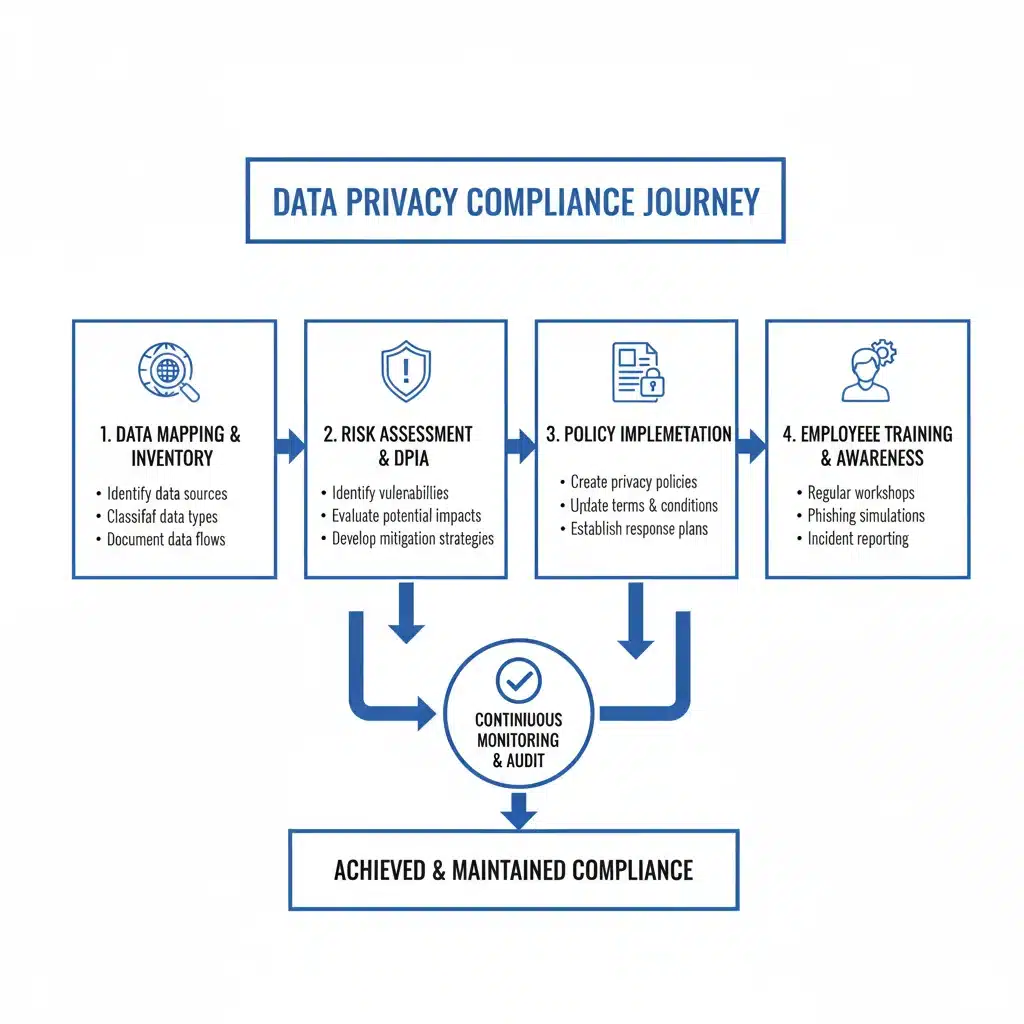
Step 2: Risk Assessment and Gap Analysis
Once you have a clear picture of your data, conduct a comprehensive risk assessment. This involves:
- Identifying potential privacy risks: Where are the vulnerabilities in your data handling practices? (e.g., inadequate access controls, insecure data transfers, lack of consent mechanisms).
- Evaluating the likelihood and impact of these risks: How probable is a data breach or privacy violation, and what would be its consequences?
- Performing a gap analysis: Compare your current privacy practices against the requirements of applicable US Data Privacy 2026 laws (e.g., CPRA, VCDPA, CPA, HIPAA). Identify areas where your practices fall short.
- Conducting Data Protection Impact Assessments (DPIAs): For new projects, systems, or significant changes in data processing, performing DPIAs can help identify and mitigate privacy risks proactively.
Step 3: Policy Development and Implementation
Based on your risk assessment, develop and implement robust privacy policies and procedures. This includes:
- Updating Privacy Notices: Ensure your privacy policy is clear, concise, easily accessible, and accurately reflects your data processing activities as required by relevant state laws. It must inform consumers about their rights and how to exercise them.
- Consent Management: Implement mechanisms for obtaining valid consent where required (e.g., for certain types of data collection, marketing communications, or cookie usage). Ensure these mechanisms are transparent and allow for easy withdrawal of consent.
- Data Subject Request (DSR) Procedures: Establish clear, efficient, and well-documented procedures for handling consumer requests to access, delete, correct, or opt-out of the sale/sharing of their personal data.
- Data Security Policies: Implement strong technical and organizational security measures to protect personal data from unauthorized access, loss, or disclosure. This includes encryption, access controls, regular security audits, and incident response plans.
- Vendor Management: Vet all third-party vendors who process personal data on your behalf. Ensure they have adequate privacy and security safeguards in place and incorporate data protection clauses into contracts.
- Data Retention and Deletion Policies: Define clear policies for how long different types of data are retained and ensure secure methods for their deletion when no longer needed.
Step 4: Employee Training and Awareness
Employees are often the first line of defense – and potentially the weakest link – in data privacy. Regular and comprehensive training is essential:
- General Privacy Awareness: Educate all employees on the importance of data privacy, the types of personal data your company handles, and their role in protecting it.
- Specific Policy Training: Provide detailed training on your company’s privacy policies and procedures, including how to handle DSRs, identify and report security incidents, and use data securely.
- Role-Specific Training: Employees with access to sensitive data or involved in data processing (e.g., HR, marketing, IT) require specialized training tailored to their responsibilities.
- Phishing and Social Engineering Awareness: Train employees to recognize and avoid common cyber threats that can lead to data breaches.
A well-informed workforce is a critical asset in maintaining US Data Privacy 2026 compliance.
Step 5: Regular Monitoring, Auditing, and Adaptation
Data privacy compliance is not a one-time project; it’s an ongoing process. The legal and technological landscapes are constantly evolving, requiring continuous vigilance:
- Regular Audits: Conduct periodic internal and external audits of your privacy practices to ensure ongoing compliance with all applicable laws and internal policies.
- Incident Response Plan Testing: Regularly test your data breach incident response plan to ensure it is effective and that your team can respond swiftly and appropriately in the event of a security incident.
- Stay Updated on Legislation: Actively monitor legislative developments at both federal and state levels. Subscribe to legal alerts and engage with privacy professionals to stay informed about new laws or amendments to existing ones concerning US Data Privacy 2026.
- Technology Updates: Keep your security technologies and data protection tools up-to-date.
- Feedback Loops: Establish mechanisms for employees and customers to provide feedback or report concerns related to data privacy.
Emerging Trends and Future Considerations for US Data Privacy 2026
Beyond current laws, several trends will shape the future of US Data Privacy 2026:
- Increased Focus on AI and Data Ethics: As AI adoption grows, expect greater scrutiny on how personal data is used to train AI models, potential biases, and the ethical implications of automated decision-making. Future regulations may specifically address AI’s impact on individual privacy.
- Biometric Data Protection: Laws governing the collection and use of biometric data (e.g., fingerprints, facial recognition) are likely to become more stringent, following states like Illinois which have led the way with the Biometric Information Privacy Act (BIPA).
- Data Broker Regulation: There’s growing interest in regulating data brokers – companies that collect and sell personal information. Future laws may impose stricter registration, transparency, and opt-out requirements on these entities.
- Cross-Border Data Transfers: While primarily a concern for international companies, US businesses engaging in global operations will need to navigate complex rules around cross-border data transfers, especially as global privacy standards continue to converge and diverge.
- Privacy-Enhancing Technologies (PETs): The adoption of PETs, such as differential privacy, homomorphic encryption, and secure multi-party computation, will likely accelerate. Regulators may even encourage or mandate their use in certain contexts to enhance privacy protections.
Companies that proactively integrate these emerging considerations into their privacy strategies will be better positioned for long-term compliance and success.

Building a Culture of Privacy
True compliance with US Data Privacy 2026 laws goes beyond checking boxes and implementing technical controls. It requires fostering a deep-rooted culture of privacy throughout the organization. This means:
- Leadership Buy-in: Data privacy must be championed from the top down. Senior leadership needs to communicate its importance and allocate necessary resources.
- Privacy by Design: Integrate privacy considerations into every stage of product development, service delivery, and business process. Don’t treat privacy as an afterthought.
- Transparency: Be open and honest with customers about your data practices. Clear communication builds trust.
- Accountability: Assign clear roles and responsibilities for data privacy within the organization. Consider appointing a dedicated Privacy Officer or Data Protection Officer (if required or beneficial).
- Continuous Improvement: View privacy compliance as an iterative process. Learn from incidents, adapt to new threats, and continuously seek ways to enhance your data protection posture.
Conclusion: Your Path to US Data Privacy 2026 Mastery
The landscape of US Data Privacy 2026 is complex, dynamic, and fraught with financial and reputational risks for non-compliant companies. However, by adopting a proactive, strategic, and comprehensive approach, your business can not only navigate these challenges but also transform data privacy into a competitive differentiator.
From meticulous data inventory and robust risk assessments to the implementation of strong policies, continuous employee training, and vigilant monitoring, every step is crucial. The potential for fines exceeding $50,000 for even minor infractions underscores the urgency of this endeavor. Embrace the principles of privacy by design, foster a culture of accountability, and stay agile in the face of evolving regulations.
By investing in robust data privacy practices now, US companies can build stronger customer relationships, safeguard their brand, and secure their place in the digital economy of 2026 and beyond. Don’t wait for a penalty to act; make data privacy a cornerstone of your business strategy today.