Mastering Your 2026 Social Security Benefits: A Comprehensive Guide

Anúncios
Understanding your future Social Security benefits is a cornerstone of effective retirement planning. As we approach 2026, many individuals are beginning to look ahead, wondering how their benefits will be calculated and what steps they can take today to maximize their future income. The 2026 Social Security Benefits landscape, while built on established rules, will have its own nuances and considerations that warrant a thorough exploration. This comprehensive guide is designed to demystify the process, empower you with knowledge, and help you navigate the complexities of the Social Security system.
Retirement might seem a distant dream for some, while for others, it’s just around the corner. Regardless of where you are on your journey, comprehending your potential Social Security income is crucial. It’s not just about knowing a number; it’s about understanding the factors that influence that number, the implications of your claiming decisions, and how these benefits integrate into your broader financial strategy. The Social Security Administration (SSA) provides tools and resources, but a deeper dive into the specifics of 2026 Social Security Benefits can illuminate pathways to a more secure and comfortable retirement.
Anúncios
The Foundation: How Social Security Benefits Are Calculated
Before we delve into the specifics of 2026 Social Security Benefits, it’s essential to grasp the fundamental principles that govern how your benefits are calculated. The Social Security Administration uses a formula that takes into account your lifetime earnings, specifically your 35 highest-earning years. If you have fewer than 35 years of earnings, zero earnings years will be factored into the calculation, which can significantly reduce your benefit amount.
Average Indexed Monthly Earnings (AIME)
The first step in calculating your benefit involves determining your Average Indexed Monthly Earnings (AIME). Your earnings from past years are ‘indexed’ to account for changes in average wages over time. This process brings your past earnings up to a comparable level with more recent earnings. For example, an income of $10,000 in 1980 would be worth significantly more in today’s dollars, and indexing adjusts for this. The SSA then calculates your average monthly earnings from your 35 highest indexed earning years.
Anúncios
Primary Insurance Amount (PIA)
Once your AIME is established, the SSA applies a progressive formula to determine your Primary Insurance Amount (PIA). The PIA is the benefit you would receive if you claim Social Security at your Full Retirement Age (FRA). This formula uses "bend points" that apply different percentages to different segments of your AIME. For instance, a higher percentage is applied to lower portions of your AIME, meaning Social Security is progressive and replaces a larger percentage of income for lower earners than for higher earners.
Factors Influencing Your 2026 Social Security Benefits
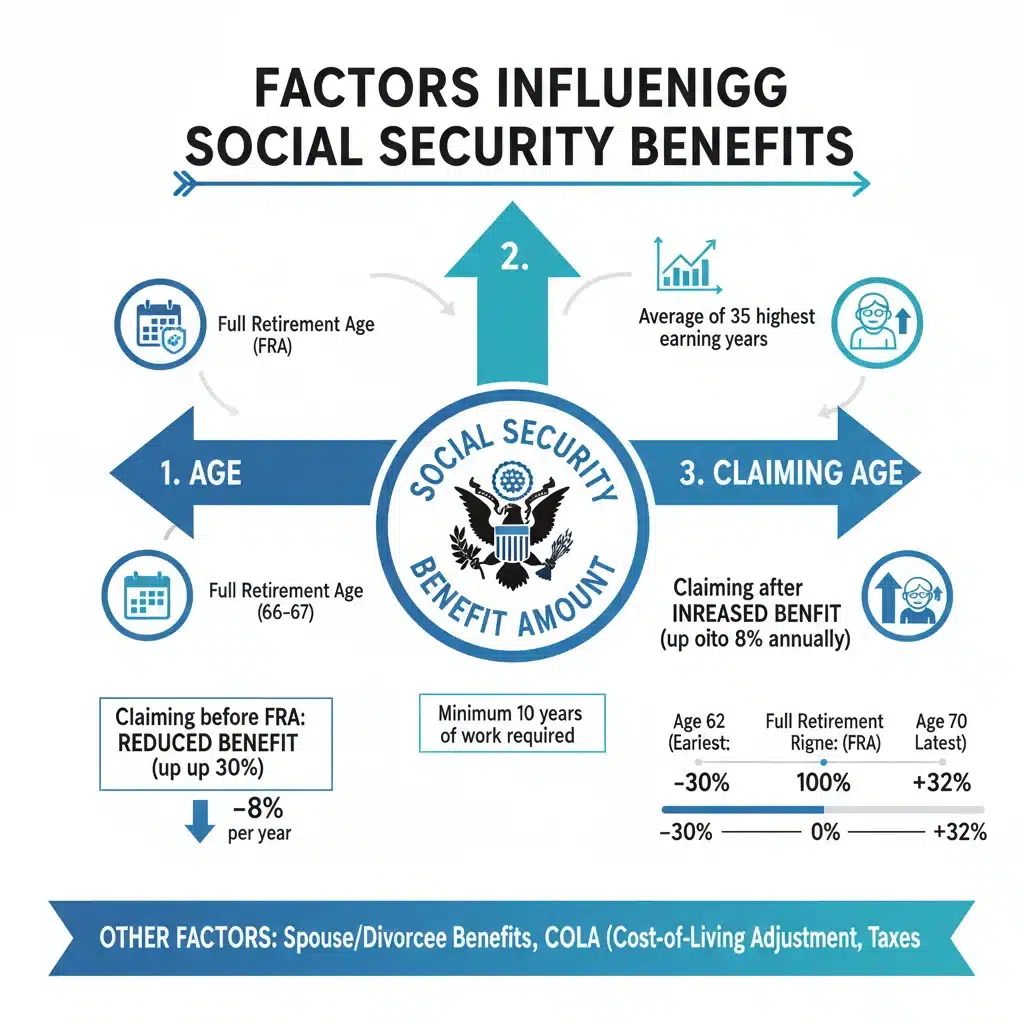
- Earning History: As mentioned, your 35 highest earning years are crucial. Consistent, high earnings over a long career will generally lead to higher benefits.
- Full Retirement Age (FRA): This is the age at which you are entitled to 100% of your PIA. For those born in 1960 or later, FRA is 67. Claiming before or after your FRA will adjust your benefit amount.
- Claiming Age: You can claim Social Security benefits as early as age 62, but your benefits will be permanently reduced. Conversely, delaying benefits past your FRA, up to age 70, will result in increased benefits due to delayed retirement credits.
- Cost-of-Living Adjustments (COLAs): Social Security benefits are subject to annual COLAs, which are designed to help benefits keep pace with inflation. The COLA for 2026 will be announced in late 2025 and will impact the actual dollar amount you receive.
- Taxes on Benefits: A portion of your Social Security benefits may be subject to federal income tax if your "provisional income" exceeds certain thresholds. This is an important consideration for your overall retirement income planning.
- Spousal and Survivor Benefits: Your work record can also provide benefits for your spouse or survivors, further enhancing the value of your Social Security contributions.
Understanding these foundational elements is the first step toward effectively planning for your 2026 Social Security Benefits. The interplay of these factors can be complex, but armed with this knowledge, you can begin to make more informed decisions.
The 2026 Social Security Benefit Calculator: Your Essential Tool
The Social Security Administration (SSA) provides a suite of online tools, including a benefit calculator, that can help you estimate your future 2026 Social Security Benefits. While the official 2026 calculator might not be live until closer to the date, understanding how current calculators work provides invaluable insight into what to expect. These calculators are designed to give you personalized estimates based on your actual earnings record.
Accessing Your Social Security Statement
The most accurate way to use any Social Security benefit calculator is by accessing your personalized Social Security Statement. You can do this by creating an account at my Social Security. Your statement provides a detailed record of your earnings history and personalized estimates of your future benefits at different claiming ages (early, full, and delayed retirement).
How the Calculator Works (Anticipating 2026)
The SSA’s online calculator typically prompts you for your birth date and your current earnings. It then uses your reported earnings history from the SSA’s records to project your future benefits. For 2026 Social Security Benefits, the calculator will assume a certain earnings trajectory for you until retirement. If your earnings change significantly, your estimates will also change. It’s crucial to regularly check your earnings record for accuracy, as errors can impact your future benefits.
Key Inputs for Accurate Estimates
- Current Age and Birth Date: These determine your Full Retirement Age and the timeframe for benefit calculations.
- Current Earnings: Your current income helps project your future earnings, impacting the "35 highest earning years" calculation.
- Future Earnings Projections: The calculator will make assumptions about your future earnings. If you anticipate significant career changes, promotions, or periods of unemployment, you might need to adjust these assumptions manually if the calculator allows, or understand that the estimate might not perfectly reflect your reality.
- Desired Retirement Age: This is perhaps the most critical input, as it directly impacts whether your benefits are reduced, full, or increased.
Using the Social Security Benefit Calculator is not a one-time event. It’s a dynamic tool that should be revisited periodically, especially as your financial situation or retirement plans evolve. Think of it as a living document that helps you refine your strategy for maximizing your 2026 Social Security Benefits and beyond.
Maximizing Your 2026 Social Security Benefits: Strategic Considerations
Simply understanding how benefits are calculated isn’t enough; the real power lies in strategically planning to maximize your 2026 Social Security Benefits. There are several key decisions and actions you can take to significantly impact the amount of money you receive throughout your retirement.
The Power of Delaying Benefits
One of the most impactful strategies for increasing your Social Security benefits is delaying your claim past your Full Retirement Age (FRA). For every year you delay claiming benefits beyond your FRA, up to age 70, you earn delayed retirement credits. These credits permanently increase your monthly benefit amount. For those with an FRA of 67, delaying until age 70 can result in an increase of approximately 24% over your FRA benefit. This is a guaranteed, inflation-adjusted return on your decision, making it a powerful tool for longevity planning, especially if you anticipate a long retirement.
Understanding Your Full Retirement Age (FRA)
Your FRA is critical. Claiming before your FRA results in a permanent reduction in benefits. For example, claiming at age 62 with an FRA of 67 means your benefits could be reduced by up to 30%. While claiming early might be necessary for some due to health issues or job loss, it’s vital to understand the long-term financial implications. Knowing your FRA is the baseline for all other claiming decisions regarding your 2026 Social Security Benefits.
Spousal and Survivor Benefits
Social Security isn’t just about individual benefits; it also provides crucial protections for families. If you are married, divorced (under certain conditions), or widowed, you may be eligible for spousal or survivor benefits based on your current or former spouse’s earnings record. These benefits can significantly enhance a household’s retirement income. For instance, a spouse may be able to claim a benefit equal to up to 50% of their partner’s full retirement age benefit. Understanding these rules is crucial for optimizing household 2026 Social Security Benefits.
Working While Receiving Benefits
If you claim benefits before your FRA and continue to work, your benefits may be temporarily reduced if your earnings exceed certain limits. This is known as the "earnings test." However, these withheld benefits are not lost; they are factored back into your benefit calculation when you reach your FRA, increasing your monthly payments moving forward. Once you reach your FRA, the earnings test no longer applies, and you can earn as much as you want without your Social Security benefits being reduced.
The Importance of Your Earnings Record
Your Social Security benefits are directly tied to your earnings history. The SSA uses your 35 highest-earning years to calculate your benefit. Therefore, consistent employment and higher earnings throughout your career contribute to a more substantial benefit. Regularly checking your Social Security statement for accuracy is paramount. Incorrect earnings reported to the SSA can lead to lower benefits, so it’s essential to rectify any discrepancies promptly. This proactive approach ensures your 2026 Social Security Benefits accurately reflect your contributions.
Integrating Social Security into Your Broader Retirement Plan
Your 2026 Social Security Benefits are just one piece of your overall retirement income puzzle. For a truly secure retirement, it’s essential to integrate your anticipated Social Security income with other financial resources, such as pensions, 401(k)s, IRAs, and personal savings. A holistic approach ensures you have a comprehensive strategy to meet your financial goals.
Estimating Your Retirement Expenses
Before you can determine if your Social Security benefits, combined with other savings, will be sufficient, you need a clear understanding of your projected retirement expenses. This includes housing, healthcare, transportation, food, and leisure activities. Many retirees find their expenses change in retirement, with some costs (like commuting) decreasing, while others (like healthcare) potentially increasing. A realistic budget is the foundation of effective retirement planning.
The Role of Other Retirement Accounts
Social Security was never intended to be your sole source of retirement income. It’s designed to provide a foundational layer of protection. Therefore, contributions to 401(k)s, IRAs, and other investment vehicles are crucial. Understanding how these accounts grow and how you’ll draw from them in retirement, in conjunction with your 2026 Social Security Benefits, is vital. Consider the tax implications of withdrawals from different account types as well.
Healthcare Costs in Retirement
Healthcare is often one of the largest and most unpredictable expenses in retirement. Medicare generally begins at age 65, but it doesn’t cover all costs. You may need to factor in premiums for Medicare Part B and D, supplemental insurance (Medigap), or Medicare Advantage plans, as well as out-of-pocket expenses for deductibles, co-pays, and services not covered by Medicare. Planning for these costs is paramount, as they can significantly impact the adequacy of your 2026 Social Security Benefits and other income sources.
Longevity Risk and Inflation
People are living longer, which means your retirement savings need to last for a longer period. This introduces longevity risk. Additionally, inflation erodes the purchasing power of your money over time. While Social Security benefits include COLAs, they might not always keep pace with your personal inflation rate, especially for specific expenses like healthcare. Your overall financial plan should account for these factors to ensure your income streams, including your 2026 Social Security Benefits, remain sufficient throughout your retirement.
Seeking Professional Financial Advice
Retirement planning can be complex, and making optimal decisions regarding your 2026 Social Security Benefits often benefits from professional guidance. A qualified financial advisor can help you:
- Analyze your complete financial picture.
- Develop a personalized retirement income strategy.
- Understand the intricacies of Social Security claiming strategies, especially for couples.
- Plan for taxes, healthcare, and estate planning.
While online calculators and resources are valuable, a human expert can provide tailored advice that considers your unique circumstances and goals, ensuring you make the most of your 2026 Social Security Benefits.
Common Misconceptions About 2026 Social Security Benefits
The Social Security system is often misunderstood, leading to common myths that can derail effective retirement planning. Dispelling these misconceptions is crucial for anyone looking to optimize their 2026 Social Security Benefits.
Myth 1: Social Security Will Run Out
This is a pervasive fear, but it’s largely unfounded. While Social Security faces long-term financial challenges, it is not projected to "run out." It’s funded by payroll taxes, meaning as long as people are working, money will flow into the system. Projections from the Social Security Administration indicate that without congressional action, the trust funds may only be able to pay a reduced percentage of promised benefits in the future (e.g., around 80%). This means benefits might be lower than currently projected, but they won’t disappear entirely. Understanding this distinction is vital for accurate planning around your 2026 Social Security Benefits.
Myth 2: My Benefits Will Be Tax-Free
While some people’s Social Security benefits are tax-free, many retirees find a portion of their benefits subject to federal income tax. If your "provisional income" (which includes half of your Social Security benefits, plus tax-exempt interest, and other adjusted gross income) exceeds certain thresholds, up to 85% of your Social Security benefits may be taxable. This is a critical factor to consider when estimating your net retirement income from your 2026 Social Security Benefits.
Myth 3: It’s Always Best to Claim at 62
Claiming at age 62 results in a permanently reduced benefit. While it might be the right choice for some individuals facing health issues, unemployment, or a desire to retire early, it’s not universally the "best" option. For many, delaying benefits until Full Retirement Age or even age 70 can significantly increase their lifetime income, especially if they have other sources of income to bridge the gap. The optimal claiming age for your 2026 Social Security Benefits depends entirely on your personal circumstances, health, and financial situation.
Myth 4: Social Security Benefits Are Only for Retirees
Social Security provides more than just retirement benefits. It also offers disability benefits for those unable to work due to a severe medical condition, and survivor benefits for eligible family members of a deceased worker. These aspects of Social Security provide a vital safety net for millions of Americans, extending beyond just traditional retirement income. Understanding the full scope of Social Security’s offerings can be beneficial for comprehensive financial planning.
Myth 5: My Social Security Statement is Always 100% Accurate
While the SSA strives for accuracy, errors can occur. Missing or incorrect earnings information on your Social Security statement can lead to lower benefits. It’s crucial to review your statement annually, especially your earnings record, and report any discrepancies to the SSA promptly. Correcting errors early can ensure your 2026 Social Security Benefits are calculated based on your true earnings history.

The Future of Social Security and Your 2026 Benefits
The Social Security system is dynamic, subject to ongoing legislative discussions and economic shifts. While the core calculation methods are stable, changes can occur that might impact your 2026 Social Security Benefits and beyond. Staying informed is key to adapting your retirement strategy.
Potential Legislative Changes
Policymakers frequently debate potential reforms to ensure Social Security’s long-term solvency. These discussions often involve various proposals, such as:
- Adjusting the Full Retirement Age: Gradually increasing the FRA for future generations.
- Modifying the COLA Formula: Changing how cost-of-living adjustments are calculated, potentially leading to smaller annual increases.
- Raising the Payroll Tax Cap: Currently, earnings above a certain threshold are not subject to Social Security taxes. Raising or eliminating this cap would increase revenue.
- Increasing the Payroll Tax Rate: A direct increase in the percentage of earnings taxed for Social Security.
While no specific changes are guaranteed, being aware of these ongoing discussions helps you understand the potential landscape for future 2026 Social Security Benefits and beyond. It underscores the importance of a diversified retirement plan that doesn’t solely rely on Social Security.
Economic Factors and COLAs
The Cost-of-Living Adjustment (COLA) for your 2026 Social Security Benefits will be determined by inflation rates in late 2025. COLAs are designed to preserve the purchasing power of benefits. High inflation years typically lead to higher COLAs, while low inflation years result in smaller or no COLAs. Economic conditions, therefore, directly influence the actual dollar amount you receive. Monitoring inflation trends can give you a rough idea of potential COLA adjustments.
The Importance of Personal Responsibility
Given the potential for future adjustments to the Social Security system and the ever-present economic uncertainties, personal responsibility in retirement planning becomes even more critical. While your 2026 Social Security Benefits will provide a foundational income, building robust personal savings, investments, and other income streams will give you greater financial security and flexibility in retirement. Diversifying your retirement income sources is the best defense against unforeseen changes to any single component, including Social Security.
Conclusion: Proactive Planning for Your 2026 Social Security Benefits
Navigating the world of Social Security benefits, particularly as you look towards 2026 Social Security Benefits, requires a blend of understanding, strategic planning, and proactive engagement. By familiarizing yourself with how benefits are calculated, utilizing the available online calculators, and making informed decisions about when to claim, you can significantly impact your financial well-being in retirement.
Remember that your Social Security benefits are a vital component of your retirement income, but they are rarely the sole source. Integrate your anticipated 2026 Social Security Benefits with your other savings, investments, and retirement accounts to create a comprehensive and resilient financial plan. Regularly review your Social Security statement, stay informed about potential legislative changes, and consider seeking professional financial advice to ensure you are making the best decisions for your unique situation.
The journey to a secure retirement is ongoing, and understanding and optimizing your 2026 Social Security Benefits is a powerful step in that direction. Start planning today, stay informed, and build the financial future you envision.